
Living trusts for Kansas families. Custom-built and fully funded, since 1998.
Trust Attorney in Leawood, Kansas
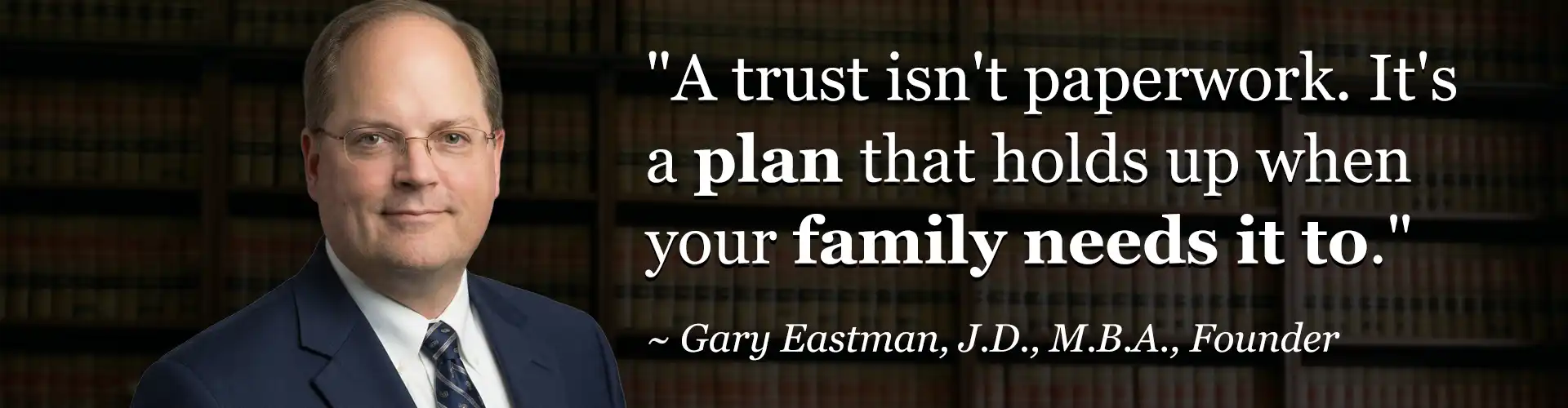
“A trust that isn’t built right and isn’t funded right won’t do what you need it to do when the time comes. It’s just useless paperwork. After 27 years, my job hasn’t changed: design it right for your family, fund it the day you sign, and stand behind it”
— Gary Eastman
What Happens to Your Family If You Don’t Have a Trust?
A will isn’t a plan. It’s a list of instructions handed to a court. The court reads it, charges your family fees to process it, takes months to release the assets, and makes the whole thing part of the public record. Your family doesn’t inherit until probate is done.
That’s the default in Kansas. It’s what happens when you do nothing or when you stop at a will.
A trust is the difference.
Built right and funded right, a trust hands your assets to the people you chose, in the way you chose, on the timeline you chose.
- No court.
- No filing fees.
- No public record.
- No waiting nine months while bills pile up.

It also handles what a will can’t.
A will doesn’t help if you’re alive but incapacitated. A will doesn’t let you control how a young or vulnerable beneficiary inherits. A will doesn’t protect a blended family from the wrong outcome. A will doesn’t keep your affairs private.
A trust does all of that.
After 5,423 trusts drafted across 27 years, the conversation that comes up most often isn’t about whether a trust is the right tool. It’s about whether the trust you have was built and funded to actually do the job. Many weren’t.
Online template trusts and flat-fee package trusts often look the part but aren’t built to hold up. Gary will tell you on your free 15-minute call whether a trust fits your situation, and whether what you have or what you’re considering will actually do its job.
Find out if a trust fits your situation. Click one of the buttons below.
What Happens When You Contact Us
Many people who call us aren’t sure whether a trust is the right move for their situation. The intake is built around that question. We keep it simple.
Step 1: Reach out by phone or form. Call (913) 908-9113 or submit our online contact form. Either goes directly to Gary, not a staff inbox. Gary answers calls personally when available. If he’s with another client, leave a brief message. Gary returns calls within 60 minutes during business hours, usually faster. Form submissions get a callback inside the same window.
Step 2: Schedule your free 15-minute call with Gary. Most consultations happen within three business days. You describe what’s going on. He asks a few questions, listens, and tells you what he thinks the right next step is. That’s the whole point of the call. Not to sell you a trust. Not to schedule billable time. To figure out what you actually need.
- Sometimes the answer is a trust.
- Sometimes the answer is a will plus other tools, and a trust would be overkill.
- Sometimes the answer is that what you already have works fine and you don’t need us at the moment. We’d rather tell you that than sell you something that won’t do its job. After 27 years, that honesty is also the reason a lot of our clients come from referrals.
- If a trust is the right move, the next step is a paid consultation that goes deeper on your situation, your family, your assets, and what the trust needs to do.
Our Living Trust Package is priced as a flat fee - $2,950 to $3,950 for couples, $950 to $1,950 for individuals (depending on complexity).
Anything outside the standard package, additional deeds, irrevocable trusts, special-needs planning, or business succession integration, is billed at our hourly rates: $350 to $490 per hour for attorney work, $150 to $190 per hour for paralegal work. Routine work doesn’t get charged at attorney rates just because the attorney’s name is on the file.
By the end of the 15-minute call, you’ll know more about your situation than you did when you picked up the phone. Whether you hire us or not.
Do You Need a Trust? A Quick Self-Check
Trusts aren’t for everyone. They’re for the situations a will alone can’t handle well. Here are six common family situations where a trust usually makes sense:
| If this is your situation | A trust likely fits |
|---|---|
| You own a home in Kansas | Your house is usually the asset that drags your family through probate. A funded trust keeps the house out of court and in your family's hands. |
| You have minor children | A will names a guardian. It doesn't control how, when, or on what terms your kids inherit. That's what a trust does. Without one, your children may only get everything the day they turn 18, ready or not. |
| You're remarried with children from a prior marriage | A will alone usually leaves everything to your spouse and trusts them to do right by your kids later. A trust makes the arrangement binding, not optional. |
| You're worried about incapacity (stroke, dementia, accident) | A will doesn't help while you're alive. A trust lets someone you chose step in if you can't manage your affairs anymore, without a judge involved. |
| You have significant retirement accounts, life insurance, or investment accounts | Every account has its own beneficiary form. They get filled out, forgotten, and may start contradicting each other over time. A trust gives the whole estate plan a single source of truth. |
| You own a business or significant business interests | Without a trust or succession plan, your business could be sold, frozen, or fought over before your family sees a dollar of it. A trust keeps the business running while everything else gets sorted out. |
If two or more of these describe your situation, a trust is probably worth a 15-minute call. If only one applies, a will plus other tools may be enough. The call is where we figure out which is the right way to go.
The Living Trust Package
The Living Trust Package is the work we do most. Here’s what it costs, what’s in it, and where it sits in the market.
What it costs
Range depends on complexity. Simpler estates land at the lower end. Estates with business interests, multi-state property, or unusual family structures land higher. We'll quote you a specific number after the consultation, before any work begins.
What's included
Seven documents, drafted together so they actually work together.
| Revocable Living Trust with testamentary and credit shelter terms | The core document. Holds your assets during your lifetime, directs how they pass when you're gone, with tax-planning provisions built in for couples. |
| Financial Durable Power of Attorney | Names someone to manage your finances if you can't, without a court hearing. |
| Healthcare Power of Attorney | Names someone to make medical decisions for you if you can't make them yourself. |
| HIPAA Authorization | Gives the people you chose legal access to your medical records when they need it. |
| Living Will | Your written instructions about end-of-life care, so your family doesn't have to guess. |
| Specific Gift List | A separate document you can update without redoing the trust, listing personal items and who gets them. |
| One Deed | Retitles your home into the trust. Funding the trust is what makes it work, and we do this part for you. |
Where this sits in the market
| Option | Typical price | What's actually included |
|---|---|---|
| Online template (LegalZoom, Trust & Will, similar) | $200 to $500 | A document. No attorney review. No funding. Often missing the supporting documents that make the trust work. |
| Flat-fee package firm | $2,500 to $5,000 | A package of documents. Attorney involvement varies. Funding the trust is often the client's job after signing. |
| The Eastman Living Trust Package | $950 to $3,950 | Seven documents drafted by Gary, sized to your family, funded by us before you leave. One attorney, start to finish. |
A trust mill produces a document. The question is whether the document works. A trust that isn't built right and isn't funded right won't do its job when the time comes, regardless of what you paid for it.
If you need more than the package
Some estates need work the standard package doesn't cover: additional deeds for second homes or rental properties, irrevocable trusts, special-needs planning, charitable giving structures, or business succession integration. That work is billed at our hourly rates.
Attorney work: $350 to $490 per hour
Paralegal work: $150 to $190 per hour
Routine work doesn't get charged at attorney rates just because the attorney's name is on the file. We scope the work, tell you what each piece will cost, and bill against the scope. No surprises.
What "done" looks like after we build your trust
Your family has a coordinated estate plan. The trust holds and directs your assets, the powers of attorney handle incapacity, and the funding work is finished before you leave. Probate doesn't pull your family into court. The people you chose receive what you intended, in the way you intended, on the timeline you intended. Built once, maintained occasionally, and ready whenever your family needs it to work.
Questions Kansas Families Ask About Creating a Trust
Do I really need a trust if I already have a will?
A will sends your assets to probate court when you die. A trust doesn't. A will doesn't help while you're alive but incapacitated. A trust does. A will becomes public record. A trust stays private.
Is there a downside to having a trust?
Yes. A trust costs more upfront than a will. It requires funding (retitling assets into the trust's name), which takes effort. It needs occasional updates as life changes. For very simple estates with few assets and no minor children, those costs and time may not pay off. We'll tell you that on the 15-minute call when it's the honest answer.
How much does a trust cost in Kansas?
Our Living Trust Package is $2,950 to $3,950 for couples and $950 to $1,950 for individuals, depending on complexity. That includes seven coordinated documents, custom drafting, and funding the trust before you leave. Online templates cost less but skip the funding work that makes a trust actually work. The pricing section above breaks down the comparison.
What's the difference between an estate lawyer and a trust lawyer?
Most estate planning attorneys handle both. The terms describe the same work from different angles. Estate planning is the broader category (wills, trusts, powers of attorney, the whole package). Trust law is one piece of it. Gary does estate planning exclusively, which means trusts, wills, and everything that goes with them. Not personal injury, not real estate, not litigation.
Do I need to transfer my home title into a trust?
If your home is your largest asset, yes. A trust only controls what's actually titled to it. A home that's still in your individual name will go through probate even if your trust says it shouldn't. Our Living Trust Package includes preparation of one deed to retitle your home into the trust. That's part of the funding work we do before you leave.
What assets shouldn't go in a trust?
Retirement accounts (IRAs, 401(k)s) should keep individual beneficiary designations, not go into the trust. Vehicles often stay in individual name because retitling is administratively expensive. Bank accounts with payable-on-death designations may not need to be in the trust. We map all of this out during the planning conversation so the trust holds what it should and nothing else.
Can a nursing home take my house if it's in a trust?
It depends on the type of trust. A revocable trust (the kind in our standard package) doesn't protect assets from Medicaid spend-down because you still legally own them. An irrevocable trust can protect a home from nursing home claims, but only if it's set up well in advance (Medicaid has a five-year lookback period). This is a planning conversation, not a quick fix.
How long does it take to set up a trust?
From the free 15-minute call to a signed, funded trust, usually three to six weeks (may vary depending on complexity). The drafting itself takes about two weeks once we have your full information. Then a review meeting, signing, and the funding work (deed recording, asset retitling). Faster turnaround is possible when situations call for it. We'll give you a realistic timeline on the consultation call.
What happens to my trust if I move out of Kansas?
Most provisions of a properly drafted Kansas trust will work in another state because the basic structure (revocable, grantor-controlled, names beneficiaries and trustees) is portable. But state-specific provisions like homestead protections, marital property treatment, and certain tax planning clauses may need updating. If you move, schedule a review with an attorney in your new state to confirm everything still fits.
Why Clients Choose Eastman to Build Their Trust

Custom drafting, not templates
Every trust we draft is built around the family in front of us.
The standard structure is a starting point, not a finished product. Specific provisions get added or removed depending on who’s in your family, what your assets actually look like, and what you want the trust to do.
A trust mill produces the same document for every client and hopes nothing falls through the gaps.
We don’t operate that way.
Funding included, not optional
A trust only controls assets that are actually titled to it. Unfunded trusts are one of the most common reasons trusts fail to do their job.
Our Living Trust Package includes the funding work, the deed retitling, the beneficiary designation review, the account transitions, before you leave with your signed documents.
We don’t hand you paperwork and a checklist and wish you luck.
One attorney, start to finish, with the credentials to back it up
When you hire us, Gary is the attorney on your file from start to finish. The intake call, the consultation, the drafting, the signing meeting, all done by Gary or under his direct supervision. You’re not handed off to a junior associate halfway through, and the name on the signature page is also the name that knows your file.
Gary’s training is in both law and finance, J.D. and M.B.A. in Finance from the University of Kansas, and before founding this firm in 1998 he practiced at Polsinelli, an AmLaw 100 firm representing publicly traded companies in complex corporate transactions.
The pedigree is unusual for a smaller estate planning firm. The rates aren’t.
5,423 trusts drafted, in estate planning exclusively
Volume teaches things experience alone doesn’t. The provisions that hold up across decades. The provisions that fall apart when families change. The drafting choices that prevent future disputes versus the ones that create them.
We don’t do personal injury, real estate, or business litigation. Estate planning is the practice, every day since 1998. The trust we draft for you is exactly the kind of work we’ve been doing for 27 years.
60-minute callback during business hours, open every weekday
When you call (913) 908-9113, or submit our online form, it goes directly to Gary. If he’s with a client, leave a brief message. He returns calls within 60 minutes during business hours, usually faster.
We’re open Monday through Friday, including Fridays when many estate planning firms are closed.
Talk to Gary About Creating Your Trust
If anything on this page made you wonder whether a trust fits your situation, that wondering is worth a phone call. The 15-minute call is where we figure out together what you actually need, whether that's a trust, a will plus other tools, or simply confirmation that what you have is working.
If you're ready to start building, the call is also the first step of that work. We'll walk you through the package, the timeline, and what to expect. By the end of the call, you'll know more about your situation than you did when you picked up the phone. No obligation, no commitment.
Free 15-minute phone consultation. Calls returned within 60 minutes during business hours.
Serving the Kansas City Metro
What to Look At Alongside Your Trust
A trust is one piece of a complete estate plan. Here’s what else commonly comes up while we’re building yours.
ESTATE PLANNING →
A trust is the centerpiece of a good estate plan, but it isn’t the whole thing. Beneficiary designations, account titling, gift strategies, and how everything coordinates with the trust all need attention. We treat the trust as the anchor and build the rest of the plan around it.
WILL PREPARATION →
A trust handles what’s titled to it. A pour-over will catches what isn’t, anything you forgot to retitle or that came into your name late. Without one, anything missed could go through probate by itself, defeating part of why you built the trust in the first place. We draft pour-over wills as a separate engagement when your situation calls for one.
POWERS OF ATTORNEY →
A trust handles what happens after you’re gone. Powers of attorney handle what happens if you’re alive but incapacitated. The two work together, and the people you name in each may not be the same person. The package includes both financial and healthcare powers of attorney.
PROBATE ADMINISTRATION →
A funded trust is the most direct way to keep your family out of probate court. We design the trust to do exactly that. If probate happens anyway because something slipped through funding, our team handles the administration so the family isn’t navigating it alone.
ASSET PROTECTION →
A revocable trust avoids probate but doesn’t protect assets from creditors or lawsuits during your lifetime. If your situation calls for stronger protection, irrevocable structures, family limited partnerships, or specialized trusts, the trust planning conversation is the right time to think about it.
TRUST SERVICES →
We handle every stage of a trust’s life. The right service depends on where you are:
- Trust Creation
- Trust Management
- Trust Administration
TAX & FINANCIAL PLANNING →
Trusts have tax mechanics that can either work for your family or against them. Income tax, estate tax, generation-skipping considerations, and how distributions get taxed all depend on how the trust is drafted. We coordinate with your CPA or financial advisor to make the trust fit the rest of the financial picture
BUSINESS SUCCESSION →
If you own a business, the trust is only one piece of the succession plan. Operating agreements, buy-sell agreements, and trustee authority over business interests all need to coordinate with the trust, or your successors inherit confusion instead of a business.
START YOUR PLAN →
A 15-minute call is the cleanest way to find out whether a trust fits your situation and what a complete plan would look like for your family. No obligation, no commitment. By the end of the call, you’ll know more about your situation than you did when you picked up the phone.
Your Trust Questions Answered
Quick Reference
Business Name: The Eastman Law Firm
Address: 4901 W 136th St, Suite 240, Leawood, KS 66224
Hours: Monday through Friday, 8:00 AM to 5:30 PM
Phone: (913) 908-9113 - calls returned within 60 minutes (during business hours)
Parking: 45 free spaces including 6 ADA-accessible
Meetings: In-office or video conference available
What are the disadvantages of a living trust?
A living trust costs more upfront than a will. It requires funding (retitling assets into the trust's name), which takes time and effort. It needs occasional updates as life changes. For very simple estates with few assets and no minor children, the upfront cost and ongoing maintenance may not pay off. Trusts also don't avoid every kind of tax (income tax on trust earnings still applies), and they don't protect assets from your own creditors during your lifetime if the trust is revocable. We talk through these honestly on the 15-minute call so you can decide whether a trust fits your situation.
Why do people put their property in a living trust?
The most common reason is to keep their family out of probate court. Property titled to a trust transfers directly to beneficiaries without court involvement, fees, or delays. A second reason is privacy: a trust keeps the terms, the assets, and the people involved out of public records. A third reason is control: a trust lets you decide how and when beneficiaries inherit, instead of handing everything over the day probate closes. People with minor children, blended families, or specific concerns about how a beneficiary will handle an inheritance use trusts for exactly this kind of control.
What are common mistakes people make with trusts?
The biggest one is creating the trust and then not funding it. A trust only controls assets that are actually titled to it. A trust that exists on paper but doesn't hold any property does almost nothing when the time comes. Other common mistakes include naming a successor trustee who isn't qualified or willing to serve, failing to update the trust after major life changes (marriage, divorce, births, deaths, moves), letting beneficiary designations on retirement accounts and life insurance fall out of sync with the trust, and signing a self-drafted or template trust that's ambiguous or improperly executed. Every one of these creates problems your family has to sort out later.
What is the primary purpose of a revocable living trust?
A revocable living trust serves three primary purposes. First, it holds your assets during your lifetime and directs how they pass when you're gone, all without probate court involvement. Second, it handles incapacity: if you can't manage your own affairs because of illness or injury, your successor trustee can step in without a court hearing. Third, it gives you control over how and when beneficiaries inherit, including the ability to hold assets in trust for younger or vulnerable beneficiaries instead of handing everything over at once. The "revocable" part means you can change or revoke the trust at any time during your lifetime.
What is the best way to leave your house to your children?
For most Kansas families, the cleanest approach is to title the house to a revocable living trust during your lifetime. The trust holds the house while you're alive (you still live there, you still control it), and when you die, the house transfers to your children through the trust without going through probate. Alternatives like joint tenancy, transfer-on-death deeds, or quitclaim deeds during your lifetime can work in narrow situations but often create unintended tax consequences, family disputes, or loss of control while you're still alive. The trust approach is usually the most flexible and the least likely to backfire.
What are the negatives to a trust vs will?
A trust costs more to set up than a will (it can be several thousand dollars more), takes longer to put in place, and requires funding (retitling assets into the trust's name) that a will doesn't. A will is quicker to draft, cheaper upfront, and doesn't require any post-signing work. The trade-off is what happens later. A will sends your assets through probate. A trust doesn't. A will is public record. A trust is private. A will doesn't help during incapacity. A trust does. For simple estates, the simpler tool may be enough. For families with assets that should avoid probate, minor children, blended-family situations, or concerns about incapacity, the trust pays for itself.
When should you do a trust instead of a will?
A trust may make more sense than a will alone when at least one of these is true: you own a home in Kansas, you have minor children, you're remarried with children from a prior marriage, you have a beneficiary who shouldn't receive a large sum directly (because of age, financial habits, government benefits, or vulnerability), you have significant assets in retirement accounts or life insurance, or you're worried about what happens if you become incapacitated. If none of these apply, a well-drafted will plus powers of attorney may be enough. The 15-minute call is where we sort out which path fits your situation.
Is LegalZoom better than Trust & Will?
The honest answer is that they're competing in the same category: template documents at template prices. Both produce a usable trust for some simple situations. Their basic products don't include an attorney reading the document to make sure it fits your family. Neither helps with funding the trust (the part that makes the trust actually work). Comparing them is choosing between two flavors of the same product. The real comparison is between template-based trust production and custom-drafted, fully funded trust planning by an attorney. That's the choice that determines whether the trust does its job when the time comes.
What is the most tax efficient way to leave your house to your children?
For many Kansas families, the most tax-efficient approach is to hold the house in a revocable living trust during your lifetime and let it pass to your children through the trust at death. This preserves the stepped-up basis (your children inherit the house at its fair market value on the date of death, not what you paid for it), which can save significant capital gains tax when they later sell. Alternatives that involve transferring the house to children during your lifetime (quitclaim deeds, joint tenancy added later, gift transfers) often lose the stepped-up basis entirely, which could cost the family tens of thousands in unnecessary capital gains tax. The trust approach is usually the cleanest both legally and tax-wise.
What is the cheapest way to do a living trust?
The cheapest way is an online template service like LegalZoom or Trust & Will, which produces a basic document for a few hundred dollars. The honest follow-up question is whether the cheapest way actually works. A template trust without attorney review, without funding, and without a custom fit for your family is paperwork that may or may not do its job when the time comes. If saving money on the upfront cost causes the trust to fail, the family pays far more in probate, taxes, and legal fees later than the savings ever amounted to. The cheapest way and the most cost-effective way are often not the same thing.
Are there monthly fees for a trust?
No, not for a revocable living trust drafted by an attorney. Once the trust is signed, funded, and in place, there's no monthly or annual maintenance fee. Updates years later (because of a divorce, a move, a change in beneficiaries, or law changes) are billed as separate engagements when you decide to make them. Some online template services charge subscription fees for ongoing access to their platform; that's a service model unique to template providers, not a feature of how trusts work.
What should I look for in a trust attorney?
Four things matter most. First, specialization: an attorney who does estate planning exclusively, not as a sideline alongside other practice areas. Second, custom drafting rather than template work, which you can usually tell by whether the attorney reads your situation before quoting a price. Third, funding included in the engagement, not handed off to you as a checklist after signing. Fourth, direct access to the attorney handling your file, not a junior associate or paralegal you don't know. Pricing varies, but the cheapest option often skips one or more of these. The one you hire should be willing to walk you through how they handle each one.
Who inherits when there is no will in Kansas?
Kansas intestate succession law decides. For many married decedents with children, the surviving spouse receives half of the probate estate and the children share the other half under K.S.A. 59-504 and K.S.A. 59-505. If there's a surviving spouse but no children, the spouse receives everything. If there are children but no surviving spouse, the children share the estate equally under K.S.A. 59-506. If there's no spouse and no children, the estate passes to parents, then siblings, then more distant relatives in a specific order. None of this is changeable after death. The only way to control who inherits is to have a valid will or trust in place beforehand.
How does a living trust work in Kansas?
A Kansas living trust is created by signing a written trust document during your lifetime. Once signed, you transfer ownership of your assets (home, bank accounts, investment accounts, business interests) from your individual name into the trust's name. You remain in control of those assets while you're alive because you serve as your own trustee. The trust spells out who serves as successor trustee if you become incapacitated or die, who the beneficiaries are, and how and when they inherit. Kansas trust law operates under the Kansas Uniform Trust Code (K.S.A. 58a), which is the governing framework for trust drafting, administration, and modification in the state.
How long does an executor have to settle an estate in Kansas?
Kansas doesn't have a strict deadline for completing probate, but the process often runs 6 to 12 months for simple estates (may vary depending on complexity). Creditors have a four-month claim window after notice is published. Tax filings (final income tax return, estate tax return if required, fiduciary income tax returns) must be completed on their own statutory deadlines. The executor has a duty to administer the estate with reasonable diligence and to keep beneficiaries informed about progress. A funded trust avoids this entire process for assets held in the trust, which is one of the main reasons people use trusts in the first place.
What assets cannot be placed in a trust?
Some assets shouldn't go into a trust even though they technically can. Retirement accounts (traditional IRAs, Roth IRAs, 401(k)s) should keep individual beneficiary designations rather than be retitled to the trust, because retitling can trigger immediate income tax consequences. Health Savings Accounts and similar tax-advantaged accounts work the same way. Vehicles often stay in individual name because retitling is administratively expensive relative to the asset value. Bank accounts with payable-on-death designations may not need to be in the trust if the designations are properly set up. Life insurance and annuities use beneficiary designations rather than trust ownership, though the trust can be named as a beneficiary in some planning strategies. We map all of this out during the planning conversation.
What is the best way to fund a trust?
Funding a trust means transferring ownership of your assets from your individual name into the trust's name. For real estate, this requires a new deed recorded with the county. For bank and investment accounts, it requires retitling the account directly through the financial institution. For business interests, it requires updating ownership records and operating agreements. For personal property, it can be transferred by a general assignment document. The best way to fund a trust is to do it systematically and completely right after the trust is signed, while the planning conversation is still fresh. Our Living Trust Package includes the funding work as part of the engagement, so you leave with the trust actually doing its job, not waiting for you to do it later.
What's the difference between a living trust and a revocable trust?
They're usually the same thing. "Living trust" describes when the trust is created (during your lifetime, while you're living). "Revocable trust" describes whether you can change or revoke it (yes, in most living trusts). Almost every living trust used in estate planning is revocable. The terms are used interchangeably in everyday conversation. The opposite of a revocable trust is an irrevocable trust, which is a different planning tool used for asset protection, Medicaid planning, or specific tax strategies. When people say "living trust" or "revocable trust" in the context of basic estate planning, they almost always mean the same document.
What is the best trust to avoid nursing home costs?
A standard revocable living trust does not protect assets from nursing home costs or Medicaid spend-down because you still legally own the assets in a revocable trust. The tool that can protect a home from nursing home claims is an irrevocable trust, sometimes structured as a Medicaid Asset Protection Trust. The catch: irrevocable trusts only work for Medicaid planning if they're set up well in advance of needing care, because Medicaid has a five-year lookback period for asset transfers. Irrevocable trusts also mean giving up control of the assets transferred, which is a meaningful trade-off. This is a planning conversation that needs to happen years before nursing home costs become a concern. We can talk through whether it fits your situation on the 15-minute call.
How do I leave my inheritance to my daughter but not son-in-law?
A trust is the cleanest tool for any situation where you want to specify who is or isn't included in the inheritance, whether that's protecting a child's inheritance from a current or future spouse, including stepchildren or grandchildren who wouldn't inherit by default, excluding an estranged family member, or providing for someone whose financial situation makes a direct inheritance risky. Specific protections include holding the inheritance in a continuing trust for your child's benefit (the child can use the assets but a spouse can't reach them), spendthrift provisions that protect against creditors and ex-spouses in future divorces, and specific exclusions that name who should not receive any part of the estate. A will alone can't do most of this work cleanly. The trust drafting conversation is where we tailor the language to your specific situation.
Schedule Your Trust Consultation Today
FREE 15-MINUTE CALL
Or Fill Out The Form Below:
NOTE: Information found on TheEastmanLawFirm.com is for general informational purposes only and should not be construed as legal advice nor a solicitation of legal business. No attorney-client relationship attaches as a result of any exchange of information, including this form or emails that are sent to the Firm. Please do not send us confidential information or sensitive materials. Unsolicited information that you send to us will not be regarded as confidential unless we have agreed to represent you. If you send an email or submit this form, you confirm that you have read and understood this notice.