
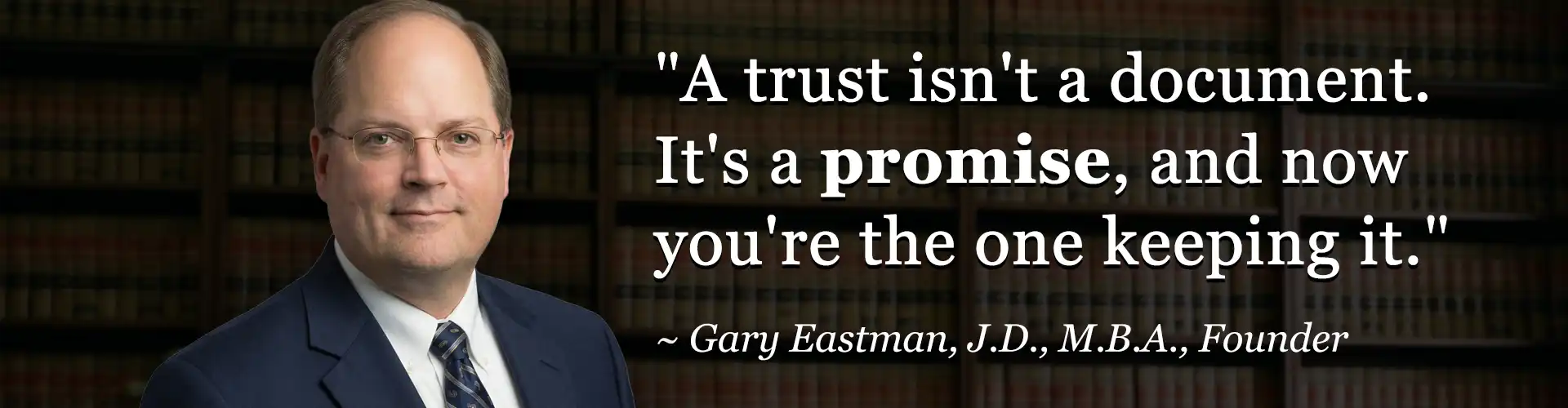
Trust administration led by the attorney who drafts these trusts, serving local families since 1998.
Trust Administration Attorney in Leawood, Kansas
“Some trust administrations are straightforward. Others get unbelievably tangled. After 27 years, my job hasn’t changed: tell families the truth, then do the work.”
— Gary Eastman
You’re On The Hook…
If you’re administering a trust, the law puts you personally on the hook.
The moment you accept the role of trustee, you become a fiduciary, a legal status that means every decision you make about the trust is judged against the duties of loyalty, impartiality, and prudence.
You’re not just a custodian. You’re the legal representative of the trust, and Kansas law holds you responsible for that representation.
Your name. Your assets. Your reputation.
If something goes wrong on your watch, the consequences land on you personally, not on the trust you’re trying to administer.

Under K.S.A. 58a-1002, a trustee in breach is personally liable for lost trust value, any profits from the breach, and potentially punitive damages.
Unlike probate, trust administration has no statutory deadline. The duty runs continuously, sometimes for years. Liability runs with it.
The exposure runs in four directions.
- Beneficiaries can sue you for breach of trust under K.S.A. 58a-1001. Their available remedies include compelling action, removing you as trustee, and recovering damages.
- Trust creditors can reach trust assets if you distribute before resolving valid claims, and the responsibility for that improper distribution lands on you.
- The court can order an accounting at any time, remove you for cause, surcharge you for losses, or deny your compensation entirely.
- The IRS and the Kansas Department of Revenue can hold you personally responsible for unpaid trust income taxes if you distributed trust funds before settling tax obligations.
THE GOOD NEWS: With the right attorney, none of this lands on you. That’s our entire job. Keep you out of all four directions, administer the trust properly, and hand the trustee role back when the work is done.
Before you make a decision you can’t undo, schedule a call.
What Happens When You Contact Us
Most people who call us have never administered a trust before. We keep the intake simple.
Step 1: Reach out by phone or form. Call (913) 908-9113 or submit our online contact form. Either goes directly to Gary, not a staff inbox. Gary answers calls personally when available. If he’s with another client, leave a brief message. Gary returns calls within 60 minutes during business hours, usually faster.
Step 2: Schedule your consultation with Gary. Most consultations happen within three business days. Gary conducts every consultation personally. You can meet in our Leawood office, by phone, or by video conference, whichever works best for you.
Consultation cost depends on what you need:
- New trust administration: the initial 15-minute call is free. We’ll review your situation, explain what the trust requires of you, and give you a realistic picture of the work and the cost. No obligation to proceed.
- Document review or specific trust questions: $245 for 30 minutes, credited toward your engagement if you decide to hire us.
By the end of the call, you’ll know more about your situation than you did when you picked up the phone. Whether you hire us or not.
How Trust Administration Works in Kansas, and How Long It Takes.
Trust administration runs in phases. Some phases overlap, some take longer than others, and a simple trust closes in less time than a complicated one. The phases are predictable. The pace varies.
| Phase | Timeframe | Key Activities |
|---|---|---|
| 1. Acceptance & Notification | First 60 days | Trustee formally accepts the role. Under K.S.A. 58a-813, qualified beneficiaries must receive formal notice within 60 days. This is the only firm statutory deadline in trust administration. |
| 2. Asset Inventory | Months 1-3 | Identify, locate, and value all trust assets. Secure property. Retitle accounts and real estate where needed. |
| 3. Tax & Financial Setup | Months 1-3 | Obtain a tax ID number for the trust. File the grantor’s final personal return. Set up trust accounting. |
| 4. Active Administration | Months 3-12+ | Manage assets prudently. Pay trust expenses. File annual trust tax returns. Resolve any creditor claims. |
| 5. Distribution | Varies by trust terms | Make distributions per the trust document. Coordinate with beneficiaries. Address tax implications. |
| 6. Final Accounting & Closure | At end | Provide final accounting to beneficiaries. Distribute remaining assets. Formally close the trust. |
The 60-day notification deadline is firm. Everything after that is paced by the trust’s complexity, asset mix, and beneficiary cooperation.
When the trust closes successfully, every beneficiary has received what the trust directs, every tax obligation has been settled, every valid creditor claim has been resolved, and the trustee is formally discharged from further responsibility. That’s the destination. The path varies by case.
A simple trust with cash, retirement accounts, and a primary residence can close in 6 to 12 months. A complicated one with real estate in multiple states, business interests, blended-family disputes, or significant tax exposure can run 18 to 36 months or longer. The 15-minute phone call is where we figure out which one yours looks like.
How Much Does Trust Administration Cost in Kansas?
Honest answer: it depends on the trust. A simple trust with cash, retirement accounts, and a primary residence costs less to administer than one with multi-state real estate, business interests, or beneficiary disputes.
Anyone who quotes you a fixed trust administration fee before knowing your situation is either lowballing you or planning to bill you for "extras" later.
We bill trust administration hourly. Two rates, full transparency:
What most firms charge
- $400 to $550 per hour, blended rate, regardless of who actually does the work
- Routine paralegal tasks billed at attorney rates
- Vague "complex matter" surcharges
- Limited cost visibility until the bill arrives
What we charge
- $350-$490/hour for attorney work, depending on which attorney handles it
- $150-$190/hour for paralegal work, because routine work shouldn't be billed at attorney rates
- No surcharges. No surprise line items.
- Detailed itemized statements so you see exactly what each hour bought
After the free 15-minute call, we can give you a realistic fee range based on the trust's actual complexity. Some trust administrations are simple. Others get unbelievably tangled. Whichever yours turns out to be, you'll know what it costs before we start the work.
Get a realistic cost range for your specific trust.
Talk to Gary. Free 15-Minute Call →Common Questions Successor Trustees Ask
Do I even need an attorney for trust administration?
Legally, no. Kansas allows trustees to administer trusts without an attorney. Practically, the question is whether the savings are worth the personal liability exposure under K.S.A. 58a-1002. The 15-minute call is where we figure out whether your situation is simple enough to handle alone.
What does trust administration cost?
We bill hourly: $350 to $490 per hour for attorney work, $150 to $190 per hour for paralegal work. Anyone quoting a fixed fee before knowing your trust's complexity is either lowballing or planning to bill you for "extras" later. After a 15-minute call, we can give you a realistic fee range based on your specific situation.
How long does trust administration take?
A simple trust with cash, retirement accounts, and a primary residence closes in 6 to 12 months. A complicated one with multi-state real estate, business interests, blended-family disputes, or significant tax exposure can run 18 to 36 months or longer. The 60-day beneficiary notification deadline is the only firm milestone; everything else paces by complexity.
What happens if I make a mistake as trustee?
Kansas trustees are personally liable for fiduciary errors. Distributing before resolving creditor claims, missing the 60-day notification deadline, mishandling tax filings, or commingling trust funds with your own can expose your personal assets to beneficiary lawsuits, court surcharge, or IRS pursuit. This is why most trustees hire an attorney. The attorney's job is mostly to keep you out of the four directions where personal liability lives.
Can I administer the trust myself?
Legally, yes. Kansas allows trustees to administer without an attorney for simpler trusts. Practically, the question is whether the savings are worth the personal liability exposure. Trusts with real estate, business interests, multiple beneficiaries, creditor disputes, or tax considerations almost always benefit from professional handling. If your situation is simple enough to do alone, we'll tell you on the call.
The trust already has another attorney. Can you take over?
Yes. Switching trust counsel mid-administration is allowed in Kansas, and we do it regularly when families aren't satisfied with their current representation. The most common reasons are slow response times, surprise bills, or feeling like the attorney is processing the trust as a transaction rather than guiding the family. We'll review where the case stands, what's been done, and what still needs to happen, then give you a realistic picture of the transition before you decide.
What documents should I bring to the consultation?
If you have them: the original trust document and any amendments, the grantor's death certificate, a list of trust assets and approximate values, a list of known debts and creditors, names and contact information for beneficiaries, and any prior estate planning documents (wills, prior trusts, powers of attorney). If you don't have all of this yet, that's fine. The phone consultation works without it.
What are your hours and how fast do you return calls?
Office hours are Monday through Friday, 8:00 AM to 5:30 PM Central. New inquiries during business hours receive a callback within 60 minutes on average. After hours and weekend messages are returned the next business morning. The Leawood office at 4901 W 136th Street, Suite 240, has 45 free parking spaces including 6 ADA-compliant spots. Most consultations from new trust administration inquiries are scheduled within 2 business days.
Can we do everything by phone or video instead of coming to the office?
The 15-minute initial consultation is by phone, not in person. After that, most ongoing trust work can be handled remotely if that's what works best for you, including Zoom meetings, document signing by mail or electronic signature, and phone updates on case status. Out-of-state successor trustees handling Kansas trusts are common in our practice and we're set up for that.
Why Successor Trustees Choose Eastman

Trust-Specific Specialization, Not General Practice
Eastman’s practice is built around one thing: helping Kansas families plan, build, and protect their estates. Trust work is the core of that practice. We’ve drafted 5,423 trusts and walked successor trustees through the administration of more of those than most attorneys will see in a career. Trust administration isn’t something we squeeze in between unrelated cases. It’s central to what we do.
Big-Firm Training, Small-Firm Service
Gary spent the early years of his career at Polsinelli, one of the top 100 law firms in the United States, where he handled more than 500 transactions ranging from $500,000 to $10 million and several over $100 million. The drafting precision, deadline discipline, and document standards from that environment carry into every trust administration we handle today, on cases of any size. Most solo and small-firm trust attorneys in Kansas don’t have that background. Verify Gary’s Kansas attorney registration.
The Same Attorney, From Drafting Through Administration
Most attorneys who draft trusts don’t administer them. Most attorneys who administer trusts didn’t draft them. The two halves of trust work usually belong to different firms with different priorities.
At Eastman, the same attorney who drafts your trust is here when the trust needs to be administered. Decisions made at drafting that affect administration get made by someone who’ll be around to handle the consequences.
A trust mill cannot say this without abandoning their volume model. Most generalist firms don’t have the trust drafting volume to make the claim.
The math is the lock.
Talk To The Attorney Who Actually Handles These
Most people who call us have never administered a trust before. We hear that on every first call. The questions you have right now are the same questions every new trustee has at the start, and we've answered them thousands of times.
Whether you're trying to figure out if you even need an attorney, what the work will cost, or what's required of you in the first 60 days, the call gives you straight answers. By the end, you'll know more about your situation than you did when you picked up the phone. Whether you hire us or someone else.
Free 15-minute phone consultation. Calls returned within 60 minutes during business hours.
Serving the Kansas City Metro
After Trust Administration, What to Look At Next
Most people who serve as a successor trustee leave the experience with new questions about their own estate. Here’s what often comes up next.
ESTATE PLANNING →
Watching a trust administered often reveals gaps in the trustee’s own plan. Build a complete framework now, from your own revocable trust to powers of attorney to coordinated beneficiary designations, so your family doesn’t navigate the same uncertainty you’re navigating today.
WILL PREPARATION →
Most successor trustees discover their own will needs updating after this experience. Whether it’s outdated guardian designations, missing pour-over language to catch assets that never made it into your trust, or beneficiaries who no longer reflect your wishes, the trustee role tends to surface what’s missing in your own plan.
POWERS OF ATTORNEY →
Trust administration covers what happens after death. Powers of attorney cover what happens if you’re alive but incapacitated. Most people who serve as trustee realize they want both bases covered, with documents that give a trusted person immediate authority over medical and financial decisions during incapacity.
PROBATE ADMINISTRATION →
When the deceased held assets outside the trust, probate runs in parallel. If you’re handling both, hand off the legal weight of court filings, creditor notices, and Kansas-specific procedural requirements so the estate is settled accurately while the trust assets stay protected and on track.
ASSET PROTECTION →
Trust administration shows how exposed assets become to creditor claims, beneficiary disputes, and tax obligations. Put structures in place for your own holdings now, from irrevocable trusts to LLCs and family limited partnerships, so the same exposures don’t reach your family later.
TRUST SERVICES →
We handle every stage of a trust’s life. The right service depends on where you are:
- Trust Creation
- Trust Management
- Trust Administration
TAX & FINANCIAL PLANNING →
Trust distributions often have tax implications worth planning around, both for the beneficiaries receiving them and for the trustee filing trust returns. The right approach can preserve more of what the trust holds and reduce the tax friction the family didn’t see coming.
BUSINESS SUCCESSION →
If you own a business, watching how trust assets transition can clarify what your own succession plan should look like. Buy-sell agreements, operating agreement updates, and documented authority for your successors keep your business from triggering a liquidity crisis or ownership fight when the time comes.
START YOUR PLAN →
Move from this experience to a concrete plan for your own family. Schedule a free 15-minute consultation to review your current documents and identify the specific gaps the trustee role has revealed.
Trust Management Questions Answered
Quick Reference
Business Name: The Eastman Law Firm
Address: 4901 W 136th St, Suite 240, Leawood, KS 66224
Hours: Monday through Friday, 8:00 AM to 5:30 PM
Phone: (913) 908-9113 - calls returned within 60 minutes (during business hours)
Parking: 45 free spaces including 6 ADA-accessible
Meetings: In-office or video conference available
What is trust administration?
Trust administration is the process of carrying out a trust's instructions after the grantor's death. The successor trustee inventories assets, notifies qualified beneficiaries within 60 days under K.S.A. 58a-813, manages and invests trust property prudently, files trust tax returns, pays valid debts, and distributes assets according to the trust document. Most trust administrations close in 6 to 12 months. Complicated ones run longer.
Do I need a lawyer for trust administration or can I do it myself?
Legally, no. Kansas allows trustees to administer trusts without an attorney. Practically, the question is whether the savings are worth the personal liability exposure under K.S.A. 58a-1002. Simple trusts with cooperative beneficiaries and basic assets may be manageable alone. Trusts with real estate, business interests, multiple beneficiaries, creditor disputes, or significant tax exposure almost always benefit from professional handling. The 15-minute call tells you which type yours is.
What are the costs of trust administration?
We bill hourly: $350 to $490 per hour for attorney work, $150 to $190 per hour for paralegal work. Total cost depends on the trust's complexity, asset types, number of beneficiaries, tax filing requirements, and length of administration. Anyone quoting a fixed fee before knowing your trust's situation is either lowballing or planning to bill you for "extras" later. After a 15-minute call, we can give you a realistic fee range.
What are my duties as trustee?
As trustee, you have several fiduciary duties: loyalty (act solely in the beneficiaries' best interests), prudence (manage trust assets carefully and reasonably), impartiality (treat beneficiaries fairly per the trust terms), to inform and report (keep qualified beneficiaries reasonably informed), and to follow the trust document. You're also legally obligated to keep trust assets separate from your personal assets, avoid conflicts of interest, and document your decisions. Breach of these duties creates personal liability.
Can I be paid for serving as trustee?
Yes, trustees are entitled to reasonable compensation unless the trust document specifically says otherwise. Kansas law allows "reasonable compensation," which typically means a percentage of trust assets (often 1% to 2% annually) or an hourly rate for time documented. Family members serving as trustee often waive compensation, especially for smaller trusts. Whatever the arrangement, beneficiaries can object to fees they consider excessive, and the court has final authority to approve or adjust trustee compensation.
How often must I provide accountings to beneficiaries?
Kansas law requires trustees to keep qualified beneficiaries reasonably informed about trust administration. At minimum, an annual accounting showing receipts, disbursements, assets, and liabilities is the baseline. Some trusts require more frequent reporting; some allow beneficiaries to waive accountings in writing. Beyond the legal minimum, regular communication is the single most effective protection against beneficiary disputes. Most trustees who get into trouble didn't do anything wrong with the assets. They stopped responding to family members.
Can I invest trust assets however I want?
No. Trustees must follow the "prudent investor rule" under Kansas law. This means diversifying investments reasonably, balancing risk and return appropriately, considering both income and growth needs, and matching the investment strategy to the trust's purposes and beneficiaries. You can't put all trust assets in a single risky investment or your own business. Investment decisions must be documented and defensible. Trustees who deviate from prudent investing principles face personal liability for resulting losses.
What if beneficiaries disagree with my decisions?
First, ensure you're acting within your authority under the trust document. Document your decision-making process and rationale. Communicate clearly with beneficiaries about why you're making specific decisions. If disagreements persist, options include mediation, requesting court instruction on contested decisions, or formal beneficiary consent procedures. Most disagreements resolve through better communication and documentation. Serious disputes may require legal counsel to navigate. Avoid making distributions or decisions while a serious disagreement is unresolved.
Can I hire professionals and pay them from trust assets?
Yes. Trustees can and should hire professionals (attorneys, CPAs, financial advisors, appraisers) when needed. Professional fees are legitimate trust expenses payable from trust assets. Fees must be reasonable, and you should ensure you're getting value for the fees paid. Hiring qualified professionals can actually reduce your liability exposure by ensuring proper compliance with legal, tax, and investment requirements. Failing to hire professionals when warranted can itself be a breach of the duty of prudence.
How do I resign as trustee?
Trustees can resign following procedures in the trust document or under Kansas law. Generally: give written notice to qualified beneficiaries and any co-trustees, ensure a successor trustee is appointed (or petition the court to appoint one), provide a final accounting to beneficiaries, formally transfer all trust assets to the successor, and obtain a release of liability where possible. Don't simply abandon the role. Improper resignation can extend your liability for events occurring after you thought you were out.
What happens if I breach my fiduciary duties?
Breach of fiduciary duty can result in serious consequences: personal liability for losses caused by the breach, removal as trustee, surcharge requiring you to restore lost value plus interest, payment of beneficiaries' attorney fees, and potential criminal charges for intentional misconduct like embezzlement. Under K.S.A. 58a-1002, damages are measured by the greater of the amount needed to restore the trust or the profit gained by breach. Punitive damages are also permitted.
What are your office hours and response times for trustee questions?
Office hours are Monday through Friday, 8:00 AM to 5:30 PM Central. New inquiries during business hours receive a callback within 60 minutes on average. After hours and weekend messages are returned the next business morning. Trustees often have time-sensitive questions about distributions, investments, or beneficiary issues, and we prioritize fast response. Most consultations from new trust administration inquiries are scheduled within 2 business days. The Leawood office has 45 free parking spaces including 6 ADA-compliant spots.
What is your track record with trust administration?
Over 27 years since 1998, Gary Eastman has drafted 5,423 trusts for Kansas families. That volume means we've walked successor trustees through the administration of more of those trusts than most attorneys will see in a career. We know what works in real-world administration, what causes problems for trustees, and what to do when a trust hasn't been funded properly or the document terms don't match current circumstances. Trust administration is central to our practice, not a sideline.
What if the trust document is unclear or outdated?
Ambiguous or outdated trust language is common. Options include: legal counsel to interpret provisions based on settlor intent and Kansas law, petitioning the court for judicial instruction, non-judicial settlement agreements (if all qualified beneficiaries agree), trust modification under Kansas Uniform Trust Code provisions, or decanting to a new trust with corrected terms. Don't proceed with unclear provisions and hope for the best. Trustees who guess on ambiguous language face personal liability if the guess is later determined wrong.
What if the trust holds property in multiple states?
Properly funded trusts avoid ancillary probate entirely because trust-titled property in any state transfers through the trust's instructions, not through the local probate court. If the deceased held real estate in another state in their individual name (not titled to the trust), that property typically requires ancillary probate in that state, running alongside the Kansas trust administration. Multi-state property is one of the most common reasons trust administrations take 18 to 36 months or longer to fully settle.
Are life insurance proceeds distributed by the trust taxable?
Generally no for income tax purposes. Life insurance death benefits are typically income tax-free to beneficiaries whether received directly or through a trust. Estate tax can apply if the deceased had "incidents of ownership" in the policy and the estate exceeds the federal exemption ($15 million per individual under current federal law). For trusts that earn interest on insurance proceeds before distribution, the interest is taxable. Distribution timing and structure can affect tax outcomes for beneficiaries.
Will an inheritance from the trust affect a beneficiary's government benefits?
Yes, direct inheritances can disqualify beneficiaries from means-tested government benefits like Supplemental Security Income (SSI), Medicaid, and subsidized housing. SSI recipients can have no more than $2,000 in countable assets. Medicaid limits vary by state and program. If the trust provides for a beneficiary on benefits, distributions may need to go to a special needs trust instead of the beneficiary directly. Trustees should verify benefit status before distributing to any beneficiary and seek counsel if benefits could be affected.
Can a trust be modified or terminated during administration?
Yes. Kansas law provides several paths: purpose achieved or impossible (the trust's intent has been accomplished or become impossible), unanimous beneficiary consent, judicial modification for changed circumstances, or non-judicial settlement agreements among all qualified beneficiaries. Modification requires careful procedure and proper documentation. Trustees who modify trust terms without following Kansas Uniform Trust Code requirements expose themselves to personal liability if a beneficiary later challenges the modification. Counsel before any modification is the safer path.
What is decanting and when is it used?
Decanting is transferring assets from an existing trust to a new trust with modified terms. It's useful when administrative provisions need updating, trustee succession needs to change, asset protection features need to be added, or drafting errors need correcting. Kansas allows decanting under specific Uniform Trust Code provisions. Restrictions apply: decanting cannot reduce vested beneficiary interests or violate the original trust's material purposes. This is an advanced trust administration technique that benefits significantly from experienced legal counsel.
Schedule Your Trust Administration Consultation Today
FREE 15-MINUTE CALL
Or Fill Out The Form Below:
NOTE: Information found on TheEastmanLawFirm.com is for general informational purposes only and should not be construed as legal advice nor a solicitation of legal business. No attorney-client relationship attaches as a result of any exchange of information, including this form or emails that are sent to the Firm. Please do not send us confidential information or sensitive materials. Unsolicited information that you send to us will not be regarded as confidential unless we have agreed to represent you. If you send an email or submit this form, you confirm that you have read and understood this notice.